Wayfarer
A travel companion for trips (2026)
A planning app for the person who always ends up organising the group trip. Its core is an AI recommendation engine - which turned out to be far less about the model than about deciding what it was allowed to do.
- Role
- Product strategy, design and build - solo
- Period
- April – July 2026
- Stack
- React PWA · TypeScript · Supabase · GPT-4o · Vercel
Overview
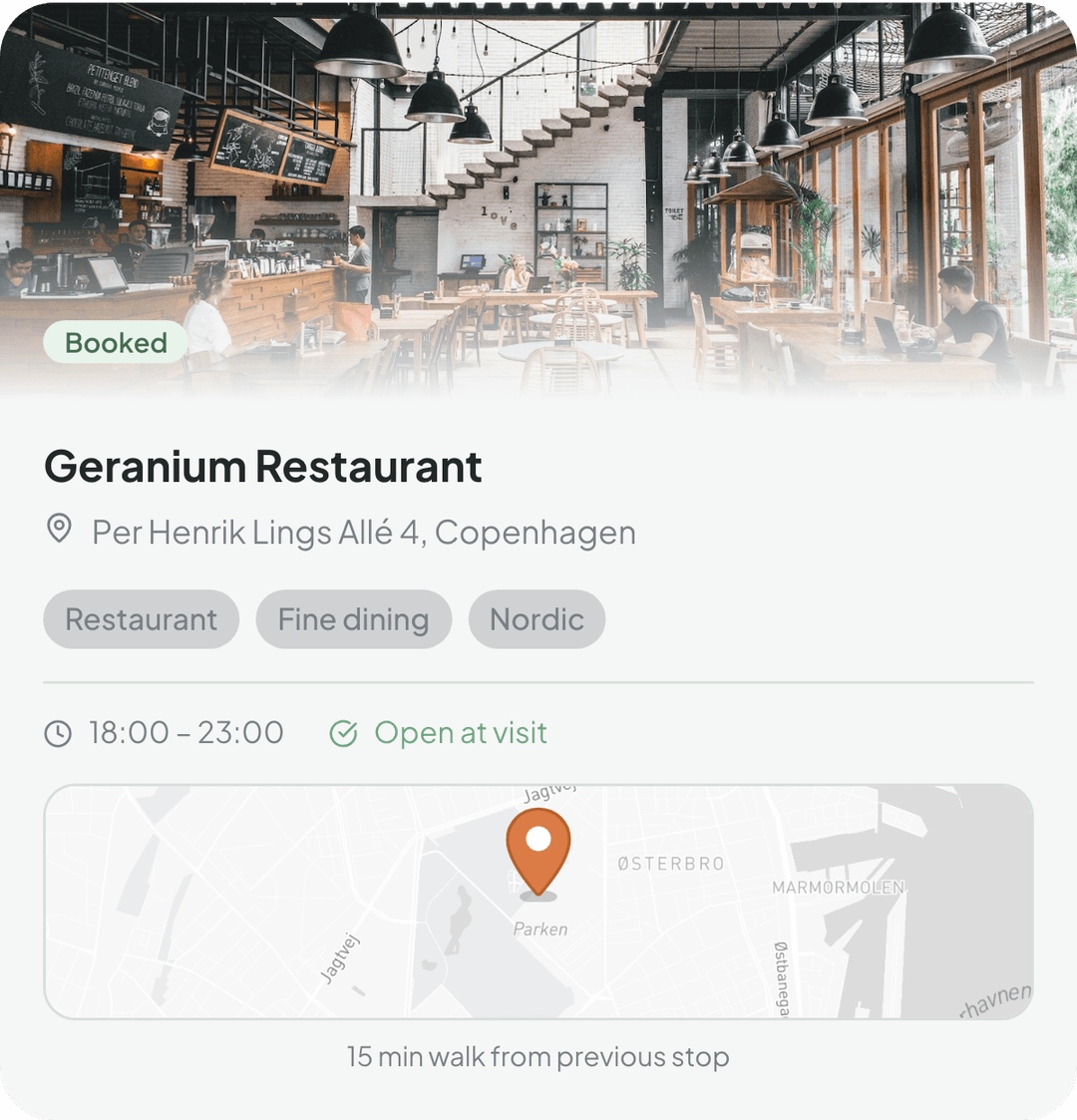
Wayfarer helps the person who ends up organising trips for a group or a family. It reduces decision anxiety by proposing smart, group-aware recommendations instead of presenting endless options. The interaction model is simple: the app proposes, the user refines.
It is not a booking platform and not a travel directory. It sits above booking and handles the planning, the in-trip decisions and the group coordination.
The problem
I started with a person rather than a feature list. Sara is 38, travels a few times a year with her partner and extended family, and is organised by nature - which is how she becomes the group’s default planner without ever volunteering.
As she plans trips, she is not short of options. She is short of a decision.
Restraint is the design job
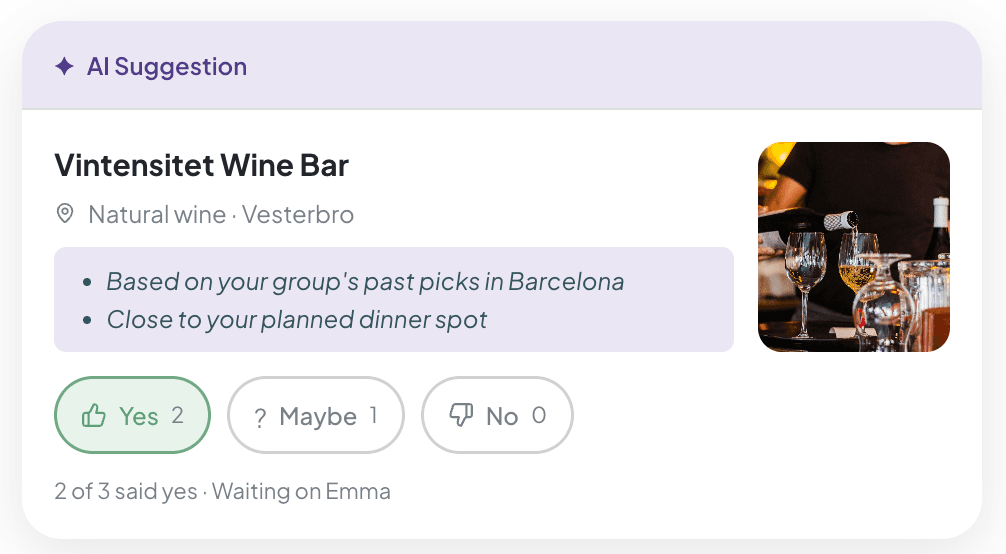
Wayfarer’s first product pillar became: a few good answers beat fifty options. Every recommendation defaults to a limited number of suggestions. No browse-and-filter, no ranked list, no comprehensive coverage.
That pillar was easy to write and hard to keep. Once a model will generate as many plausible options as you ask for, every instinct - mine and the machine’s - pushes towards showing more. A list feels generous. It also hands the decision back to the person who came to the product because they could not make it.
AI features that make sense
The most useful thing I learned here is that the model is good at matching and phrasing, and bad at being a database.
Left to its own knowledge, it will name restaurants with total confidence. Some have closed. Some were never real.
So the feature was rebuilt around the limitation. When someone asks for something concrete, Wayfarer searches for real places first and injects up to twenty verified candidates into the prompt. The model’s job shrinks to picking the right one and explaining why it fits.
The same principle shaped what the app remembers. Learned preferences are stored as categories - the kinds of places a group goes for - rather than lists of specific venues.
Making suggestions relevant
Another pillar: trust comes from specificity, not volume. Every suggestion has to be relevant, drawn from the group’s own data. “Matches Emma’s vegetarian preference” is a good reason. “Great for families” is not - it sounds like one without saying anything.
That constraint gives the user something to evaluate, which is what makes a few good suggestions feel worth having. And it makes bad output obvious - you can see straight away when the model has latched onto the wrong thing.
Main challenges
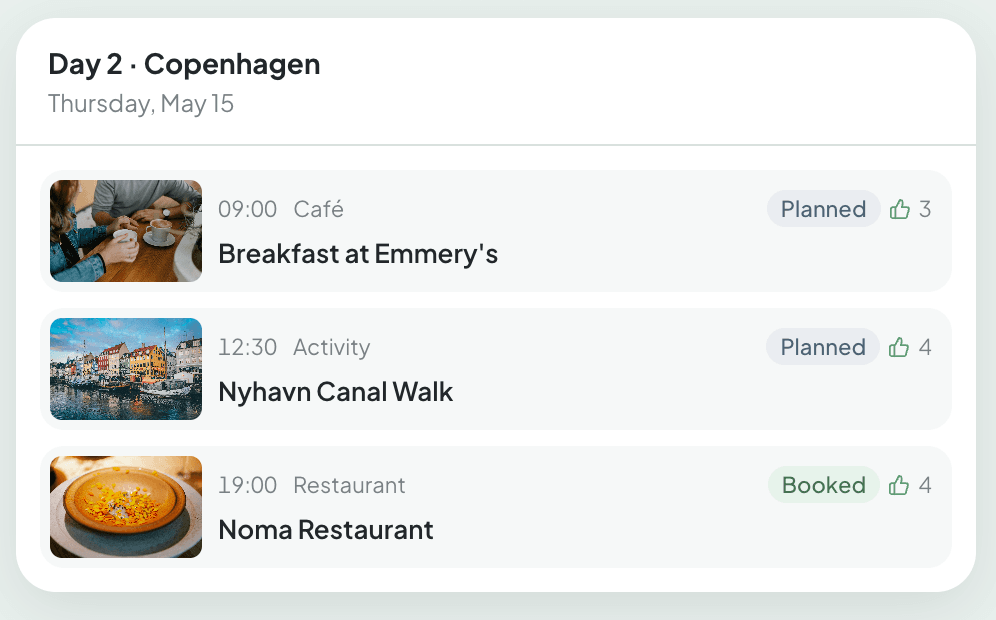
Non-determinism. Software has taught people that the same action produces the same result. An AI feature breaks this convention. Ask twice and get two answers - both reasonable, which can be worse than one of them being wrong. I mitigated it by having the plan itself stay stable and editable, and only the suggestions regenerate when needed.
Knowing when not to use AI. Once a model is wired in, it’s tempting to use it for everything. Most of Wayfarer isn’t. The model is only there where it brings clear value.
Where are we heading?
My guess is that AI features evolve to be more integrated. Right now they are visible - a sparkle icon, a thing you press to activate. That will change as the technology matures.
What I think we will see is closer to what Wayfarer does. The model sits underneath the interface and makes key moments better. There is no chat, no prompt.
If so, the skill that matters is knowing which moment in a product is worth building with AI, and having the discipline to leave other parts alone.